%20--%3e%3csvg%20width='63.297821mm'%20height='39.29665mm'%20viewBox='0%200%2063.297821%2039.29665'%20version='1.1'%20id='svg8765'%20inkscape:version='1.1%20(c4e8f9ed74,%202021-05-24)'%20sodipodi:docname='OBALogoSingle2.svg'%20xmlns:inkscape='http://www.inkscape.org/namespaces/inkscape'%20xmlns:sodipodi='http://sodipodi.sourceforge.net/DTD/sodipodi-0.dtd'%20xmlns='http://www.w3.org/2000/svg'%20xmlns:svg='http://www.w3.org/2000/svg'%3e%3csodipodi:namedview%20id='namedview8767'%20pagecolor='%23ffffff'%20bordercolor='%23666666'%20borderopacity='1.0'%20inkscape:pageshadow='2'%20inkscape:pageopacity='0.0'%20inkscape:pagecheckerboard='0'%20inkscape:document-units='mm'%20showgrid='false'%20fit-margin-top='0'%20fit-margin-left='0'%20fit-margin-right='0'%20fit-margin-bottom='0'%20inkscape:zoom='1.1759259'%20inkscape:cx='179.85827'%20inkscape:cy='102.04724'%20inkscape:window-width='1920'%20inkscape:window-height='972'%20inkscape:window-x='0'%20inkscape:window-y='27'%20inkscape:window-maximized='1'%20inkscape:current-layer='layer1'%20/%3e%3cdefs%20id='defs8762'%20/%3e%3cg%20inkscape:label='Layer%201'%20inkscape:groupmode='layer'%20id='layer1'%20transform='translate(-31.351095,-50.101677)'%3e%3cpath%20style='fill:none;stroke:%233584e4;stroke-width:3.965;stroke-linecap:square;stroke-linejoin:round;stroke-miterlimit:4;stroke-dasharray:none;stroke-opacity:1'%20d='m%2077.07508,77.78787%2014.84134,8.87817%20V%2052.83397%20L%2034.08359,86.5521%20V%2053.69366%20l%2015.27351,9.31107'%20id='path8388'%20sodipodi:nodetypes='cccccc'%20/%3e%3c/g%3e%3c/svg%3e)
Volex (VLX) Stock Analysis 2026: Momentum Leads, But Can the Fundamentals Follow?
Educational content only. This article is for educational and informational purposes only. It does not constitute financial advice or a recommendation to buy, sell, or hold any security. Investing involves risk — you may get back less than you invest. If you are unsure whether an investment is right for you, please consult a qualified financial adviser who is authorised by the Financial Conduct Authority (FCA).
At a glance
| Field | Value |
|---|---|
| Ticker | VLX |
| Exchange | AIM (Main Market move targeted before August 2026) |
| Sector | Industrials |
| Industry | Electrical Components & Equipment |
| Reward Score | 63 / 100 (Moderate) |
| Risk Score | 55 / 100 (Medium-High) |
| Forward P/E | 15.8x |
| PEG Ratio | 2.22x |
| 1-Year Return vs FTSE 100 | +75.7% |
| Next Catalyst | Preliminary full-year results, 25 June 2026 |
The Investment Thesis
Volex (AIM: VLX) is a business in transition — and the market has noticed. Openbook's reward model scores VLX at 63 / 100, a moderate reading that masks a stark internal divide. Momentum is maxed out at 100/100, driven by a share price that has outrun the FTSE 100 by 75.7% over the past year. Growth scores a reasonable 55/100 on the back of strong historical revenue expansion and a doubling of data centre revenues in the year to March 2026. But profitability, at 42/100, tells a more sobering story: thin margins, weak cash conversion, and a net margin of just 4.4% that sits well below what you would expect from a business generating this kind of stock-market excitement.
The central analytical question here is straightforward. Has momentum priced in a margin improvement that has not yet fully materialised? And if so, what is the risk if it takes longer to arrive than the market expects?
Volex Business Overview: What the Company Does
Volex is an AIM-listed integrated manufacturer specialising in power products and connectivity solutions for performance-critical applications. Its five core markets are Electric Vehicles (EV), Consumer Electricals, Medical, Complex Industrial Technology, and Off-Highway equipment. The business operates across three geographic segments — North America, Asia, and Europe — with North America generating the largest share of revenues.
After more than a decade of transformation under its current strategic direction, Volex reported revenues of at least $1.22 billion for the year ended March 2026, with data centre revenues forecast to roughly double year-on-year. The company has now set new medium-term ambitions:
- $2 billion in revenue
- 12% EBIT margins
- Returns on capital above 20%
A planned move from AIM to the London Stock Exchange Main Market, targeting admission before August 2026, would make VLX eligible for FTSE 250 inclusion — a structural catalyst that has not gone unnoticed by the market.
Openbook Reward Score: Growth and Momentum Lead, Profitability Drags
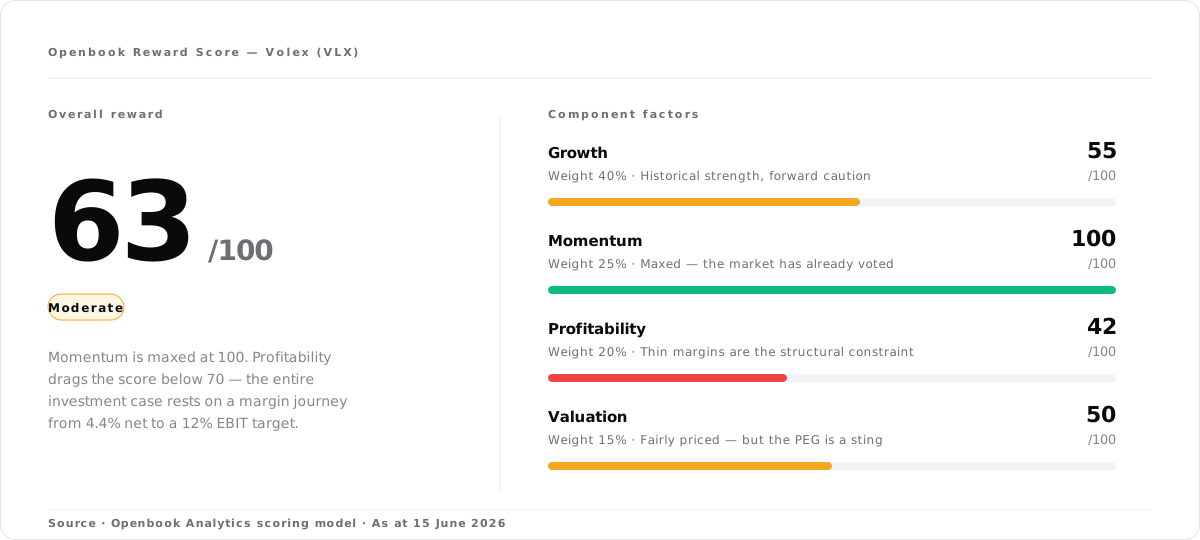
| Component | Score | Weight | Reading |
|---|---|---|---|
| Overall Reward | 63 / 100 | — | Moderate |
| Growth | 55 / 100 | 40% | Historical strength, forward caution |
| Momentum | 100 / 100 | 25% | Maxed — the market has already voted |
| Profitability | 42 / 100 | 20% | Structural constraint |
| Valuation | 50 / 100 | 15% | Fairly priced, with a sting in the tail |
Growth: 55/100 — Historical Strength, Forward Caution
| Metric | Value | Signal |
|---|---|---|
| Revenue Growth (3yr CAGR) | 22.5% | Very Good |
| Net Income Growth (3yr CAGR) | 16.4% | Good |
| Cash Flow Growth (3yr CAGR) | -5.9% | Bad |
| Revenue Growth (forward est.) | 4.7% | Neutral |
| Profit Growth (forward est.) | 7.1% | Good |
| Analyst Price Target Upside | -17.5% | Very Bad |
Growth carries 40% of the total reward weighting — the heaviest allocation in the model — and at 55/100 it is performing adequately but not spectacularly. The three-year revenue CAGR of 22.5% is genuinely impressive, reflecting both the pace of organic expansion and a disciplined acquisition strategy that includes deals like the Murat Ticaret acquisition in 2024, which added manufacturing capacity in Turkey, and the ProSys deal that bolstered data centre capabilities. Net income growth of 16.4% over the same period confirms that revenue expansion is broadly translating into earnings.
The deterioration begins when you look at forward estimates. Revenue growth is expected to fall to 4.7% and profit growth to 7.1% — both significant decelerations from the historical run rate. That step-down is not unusual for a business approaching $1.2 billion in revenues, but it matters for valuation.
More striking is the analyst price target upside reading of negative 17.5%. This means that, at current levels, the consensus of covering analysts actually places a lower value on the stock than where it is trading. That is a red flag worth sitting with. It does not mean the stock is broken — it means the market has run ahead of analyst models. Given the recent data centre rerating and the planned FTSE 250 inclusion catalyst, that is at least partially explainable. But it introduces meaningful downside risk if either catalyst disappoints.
Cash flow growth at negative 5.9% over three years is the other concern. Free cash flow per dollar of revenue is not expanding, which matters more and more as capex requirements rise to support data centre capacity and the company's North American expansion, including a new facility in Central Mexico.
Momentum: 100/100 — The Market Has Already Voted
| Metric | Value | Signal |
|---|---|---|
| 1-Year vs FTSE 100 | +75.7% | Higher Relative |
| 6-Month vs FTSE 100 | +39.7% | Higher Relative |
| 3-Month Return | +35.2% | Very Good |
| Return Consistency | +11.4% | Accelerating |
| Trading Volume Trend | +41.1% | Very Good |
Momentum scoring 100/100 is not something Openbook's model delivers lightly. It requires outperformance across multiple timeframes simultaneously, and VLX delivers across the board. The 75.7% outperformance versus the FTSE 100 over 12 months reflects the compounding impact of three specific catalysts:
- March 2026 trading upgrade driven by the data centre boom.
- April 2026 Capital Markets Event at which management set ambitious new growth targets and announced a £40 million share buyback.
- The disclosure of the planned move to the Main Market and FTSE 250 eligibility.
The volume trend of +41.1% is particularly important. Rising price with rising volume is the confirmation signal that institutional money is entering the stock, not just retail activity. With the Main Market move expected before August 2026, there is a structural argument that volume will continue to rise as FTSE index trackers acquire a position that, on AIM, they were not permitted to hold.
The risk, as always with perfect momentum, is that much of the good news is already priced. Momentum at 100/100 is a positive factor today, but it also means the stock has already moved significantly — and any disappointment in the preliminary full-year results, due 25 June 2026, could trigger a sharp reversal.
Profitability: 42/100 — The Structural Constraint
| Metric | Value | Signal |
|---|---|---|
| Gross Margin | 21.4% | Weak |
| Net Margin | 4.4% | Weak |
| Cash Conversion | 65% | Neutral |
| Operating Profit Growth (3yr) | 30.8% | Very Good |
| Return on Equity | 15.1% | Good |
| Return on Assets | 6.3% | Good |
Profitability at 42/100 is the main drag on the reward score, and it is the factor investors most need to understand before forming a view on VLX. A gross margin of 21.4% is thin for an industrial company and reflects the fundamental nature of Volex's business model: it is a manufacturer, not a software company. Margins at this level do not leave enormous room for error when input costs rise, when a customer delays orders, or when a new factory ramps more slowly than planned.
The 4.4% net margin is the number that demands most attention. At $1.22 billion in revenues, that translates to roughly $54 million in net profit. The business is profitable, but it is not highly capital efficient at the net line. Compare this to Volex's own stated ambition of 12% EBIT margins — the gap between where the business is operating today and where management wants to take it is substantial.
That gap is the thesis. If Volex executes the margin expansion journey, the investment case is compelling. If it stalls at current margin levels, the valuation at a forward P/E of 15.8x becomes much harder to justify.
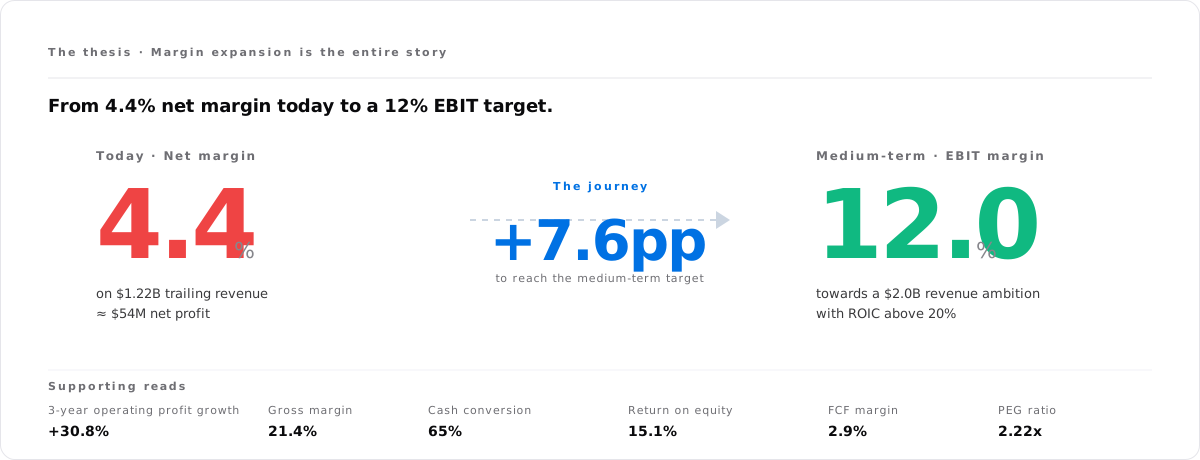
The return on equity of 15.1% and return on assets of 6.3% are both respectable readings that confirm the business generates adequate returns on the capital it employs. The operating profit growth of 30.8% over three years is strong, which suggests margins are improving at the operating level even if they have not yet filtered through fully to the net line due to financing costs and amortisation.
Valuation: 50/100 — Fairly Priced, With a Sting in the Tail
| Metric | Value | Signal |
|---|---|---|
| Growth-Adjusted P/E (PEG) | 2.22x | Higher Premium vs Peers |
| EV / EBITDA | 10.0x | Moderate Relative Value |
| Forward P/E | 15.8x | Moderate Relative Value |
| Price / Cash Flow | 26.8x | Premium vs Peers |
| Price / Revenue | 1.2x | Above-Average Relative Value |
| Net Debt / EBITDA | 1.4x | Low Leverage |
The valuation score of 50/100 sits precisely at the model average, and that balance reflects genuinely competing signals. The forward P/E of 15.8x is moderate — below the broader industrials sector average — and on the surface looks reasonable for a business with Volex's growth track record. The EV/EBITDA of 10x is similarly undemanding.
The PEG ratio of 2.22x is where the analysis becomes more uncomfortable. A PEG above 2x means the market is paying a material premium for the growth it expects. That is only justified if growth expectations are conservative — and the analyst price target upside of negative 17.5% suggests they may not be.
Put differently, at a PEG of 2.22x with forward revenue growth slowing to 4.7%, VLX is priced for a margin expansion story rather than a growth story. The Price/Cash Flow multiple of 26.8x reinforces this reading: investors are not buying today's cash flows, they are buying tomorrow's.
The low debt load of 1.4x net debt to EBITDA is a genuine positive. Management has maintained a conservative balance sheet even through an active acquisition period, and the recently announced £40 million share buyback signals confidence that the balance sheet can absorb capital returns alongside continued investment.
VLX Risk Assessment: Elevated Volatility, Solid Solvency
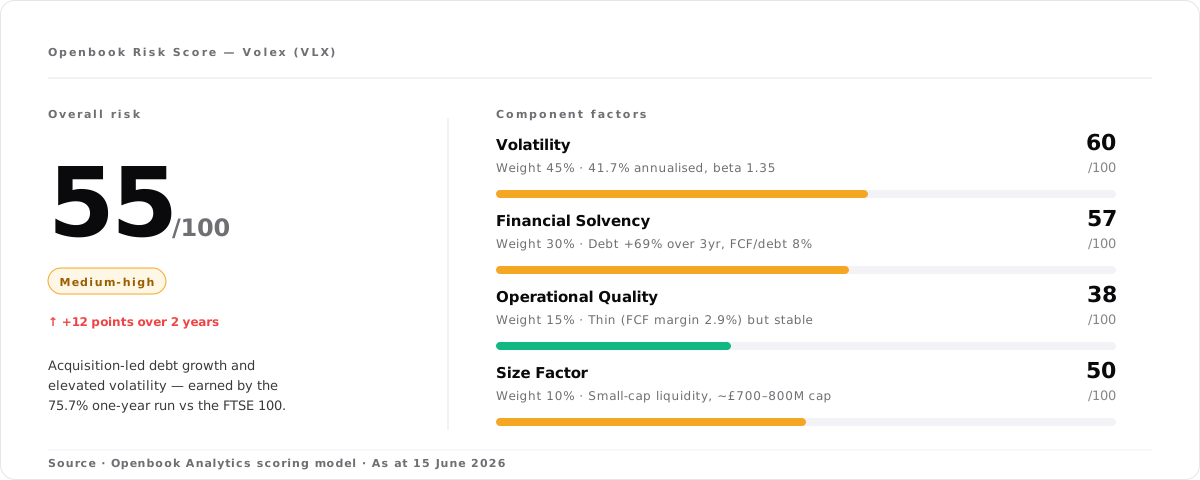
| Component | Score | Reading |
|---|---|---|
| Overall Risk | 55 / 100 | Medium-High Risk |
| Financial Solvency | 57 / 100 | Adequate |
| Operational Quality | 38 / 100 | Thin but stable |
| Volatility | 60 / 100 | The price of momentum |
| Size Factor | 50 / 100 | Small-cap liquidity risk |
Openbook's risk model scores VLX at 55/100 — medium-high risk, and up 12 points over two years. The increase reflects a business that has taken on more debt as it has grown, operates with thin margins that create earnings sensitivity to volume swings, and has delivered a share price trajectory that introduces significant downside exposure if sentiment turns.
Financial Solvency: 57/100 — Adequate, With One Warning Sign
| Metric | Value | Signal |
|---|---|---|
| Interest Coverage | 3.6x | Adequate |
| Net Debt / EBITDA | 1.4x | Conservative |
| Current Ratio | 1.49x | Adequate |
| Debt Trend (3yr) | +69% | Rapidly Deteriorating |
| FCF / Debt Coverage | 8% | Elevated Risk Band |
The solvency picture is better than the headline risk score suggests, but one metric demands attention. The three-year debt trend of +69% is flagged as rapidly deteriorating. This is the natural consequence of Volex's acquisition-led growth strategy: debt rises as the business buys revenue and manufacturing capacity. The net debt to EBITDA of 1.4x remains conservative in absolute terms, and interest coverage at 3.6x is adequate.
But the free cash flow to debt coverage of 8% sits in the elevated risk band. That means that in a stress scenario — a sudden slowdown in data centre spending, a customer loss, or an unexpected cost spike — the business would have limited FCF headroom to service debt without accessing additional credit facilities.
For long-term investors, this is not a crisis. But it does explain why the risk score has risen 12 points over two years and why investors should monitor cash generation carefully as the business scales.
Operational Quality: 38/100 — Thin Margins, But Stable
| Metric | Value | Signal |
|---|---|---|
| Net Margin | 4.4% | Thin |
| FCF Margin | 2.9% | Weak |
| Cash ROA | 8.4% | Moderate Risk Band |
| Margin Stability | ±1.3pp | Very Stable |
The FCF margin of 2.9% is the most important number in this section. Free cash flow is the real measure of a manufacturing business's health, and at 2.9% it is thin. The encouraging counterpoint is that margin stability is rated very stable at ±1.3 percentage points — meaning that while margins are thin, they are predictably thin. That consistency has value in a sector where earnings volatility can be punishing.
Volatility: 60/100 — The Price of Momentum
| Metric | Value | Signal |
|---|---|---|
| Annualised Volatility | 41.7% | Very High |
| Max Drawdown | -18.5% | Low |
| Beta | 1.35 | Moderately Aggressive |
An annualised volatility of 41.7% is very high for a business of this type, and it is the primary driver of the elevated risk score. For context, a beta of 1.35 means VLX amplifies FTSE 100 moves by roughly a third in either direction. The max drawdown of -18.5% over the measured period looks manageable, but that figure was achieved during a period of sustained upward momentum. Any reversal of sentiment — particularly around the June 2026 preliminary results or the FTSE inclusion announcement — could deepen drawdowns materially.
Investors need to understand that the 75.7% outperformance versus the FTSE 100 over the past year is not a one-way street. A stock that rises this fast, with this level of volatility and a beta above 1, can also move sharply in the other direction. Position sizing matters here.
Size Factor: 50/100 — Small Cap Liquidity Risk
With a market capitalisation of approximately £700–800 million, Volex sits at the upper end of small-cap territory. The planned Main Market move and FTSE 250 inclusion would bring structural demand from passive trackers and broaden the institutional investor base — one reason momentum has accelerated so sharply. The risk, before that transition completes, is that a large seller could move the market meaningfully in a thinly traded session.
What the Market Is Getting Right — And What It May Be Missing
The market's enthusiasm for VLX is not irrational. Data centre revenues roughly doubling in a single year is a genuinely transformational development, and Volex's positioning as a supplier of high-speed data transmission products to AI infrastructure customers puts it at the intersection of two of the most powerful secular trends of the decade. The company met its previous five-year strategic plan a year early and management has credibility. These are real advantages, and they justify a re-rating.
What the market may be underweighting is the profitability gap. A business targeting 12% EBIT margins is currently operating at net margins of 4.4%. That journey requires consistent execution across a complex global manufacturing footprint, disciplined acquisition integration, and continued volume growth to spread fixed costs. Volex is on the right trajectory — operating profit growth of 30.8% over three years confirms that. But the distance between today's margins and the medium-term ambition is large, and the PEG ratio of 2.22x implies the market has already granted partial credit for an improvement that has not yet been fully delivered.
The other factor the market is currently treating as a positive — the Main Market move — introduces a transition risk. FTSE 250 index funds will buy VLX, but they will also hold it mechanically regardless of fundamentals. New passive holders change the ownership composition of the stock and can reduce price sensitivity to operational news in both directions. For active investors, the near-term catalyst from inclusion is real, but the longer-term consequence is a more institutionally anchored shareholder base that tracks the index rather than the business.
Is Volex a Good Investment? The Analytical View
VLX presents as a high-quality business with exceptional momentum and a credible long-term growth strategy, operating today with profitability metrics that do not yet match the ambition. The reward score of 63/100 and risk score of 55/100 combine to describe a stock where the upside is real but the margin of safety is narrow.
At a forward P/E of 15.8x and a PEG of 2.22x, the market is not pricing in disaster. But it is pricing in execution. Investors should be watching three things:
- The preliminary full-year results due 25 June 2026 — and whether operating margins have exceeded the stated 9–10% target range as guided.
- Confirmation and timing of the Main Market transition and FTSE 250 inclusion.
- Whether forward revenue and profit growth estimates are revised upwards after the results — or downwards, which would be the clearest signal that the data centre tailwind is being competed away.
This is a business building towards something compelling. The margin expansion from 4.4% net to a 12% EBIT target is the story. For investors prepared to hold through execution risk and elevated volatility, the structural case is genuine. For those who need that margin improvement to be reflected in current numbers before committing, the wait for a better entry point may be a rational one.
Key Questions to Research Independently
The questions investors typically work through before sizing a position are: whether the current PEG of 2.22x prices appropriate optimism on the margin journey or excessive optimism; how durable the data centre tailwind is once supply catches up with hyperscaler demand; whether the +69% three-year debt trend is sustainable given the FCF coverage ratio of 8%; and how VLX compares to other UK industrials with data centre exposure on a risk-adjusted basis.
These are individual judgements that depend on time horizon, return objective and risk tolerance. Openbook's tools provide the data; the position-sizing decision sits with the investor.
Explore VLX's full financial data on Openbook →
This article is produced for educational purposes only and does not constitute a financial promotion, investment advice, or a personal recommendation. Past performance is not a reliable indicator of future results. The value of investments can fall as well as rise and you may get back less than you invest. Volex scores shown are model outputs based on historical financial data and are not forward-looking predictions. Openbook Analytics is not authorised by the Financial Conduct Authority to provide investment advice.
Discussion
Log in to join the discussion