%20--%3e%3csvg%20width='63.297821mm'%20height='39.29665mm'%20viewBox='0%200%2063.297821%2039.29665'%20version='1.1'%20id='svg8765'%20inkscape:version='1.1%20(c4e8f9ed74,%202021-05-24)'%20sodipodi:docname='OBALogoSingle2.svg'%20xmlns:inkscape='http://www.inkscape.org/namespaces/inkscape'%20xmlns:sodipodi='http://sodipodi.sourceforge.net/DTD/sodipodi-0.dtd'%20xmlns='http://www.w3.org/2000/svg'%20xmlns:svg='http://www.w3.org/2000/svg'%3e%3csodipodi:namedview%20id='namedview8767'%20pagecolor='%23ffffff'%20bordercolor='%23666666'%20borderopacity='1.0'%20inkscape:pageshadow='2'%20inkscape:pageopacity='0.0'%20inkscape:pagecheckerboard='0'%20inkscape:document-units='mm'%20showgrid='false'%20fit-margin-top='0'%20fit-margin-left='0'%20fit-margin-right='0'%20fit-margin-bottom='0'%20inkscape:zoom='1.1759259'%20inkscape:cx='179.85827'%20inkscape:cy='102.04724'%20inkscape:window-width='1920'%20inkscape:window-height='972'%20inkscape:window-x='0'%20inkscape:window-y='27'%20inkscape:window-maximized='1'%20inkscape:current-layer='layer1'%20/%3e%3cdefs%20id='defs8762'%20/%3e%3cg%20inkscape:label='Layer%201'%20inkscape:groupmode='layer'%20id='layer1'%20transform='translate(-31.351095,-50.101677)'%3e%3cpath%20style='fill:none;stroke:%233584e4;stroke-width:3.965;stroke-linecap:square;stroke-linejoin:round;stroke-miterlimit:4;stroke-dasharray:none;stroke-opacity:1'%20d='m%2077.07508,77.78787%2014.84134,8.87817%20V%2052.83397%20L%2034.08359,86.5521%20V%2053.69366%20l%2015.27351,9.31107'%20id='path8388'%20sodipodi:nodetypes='cccccc'%20/%3e%3c/g%3e%3c/svg%3e)
Saudi Arabia shut its East-West Crude Oil Pipeline on 11 September after drone strikes launched from Iraqi territory hit targets in the Riyadh and Madinah regions. The Ministry of Energy described the suspension as a precautionary measure. The roughly 750-mile line carries four to five million barrels a day from the eastern oilfields to the Red Sea port of Yanbu, and with the Strait of Hormuz effectively closed it had become the kingdom's only meaningful export route. Brent settled above $104 on Friday and was quoted near $108 in early Monday trade, up more than 3% on the session.
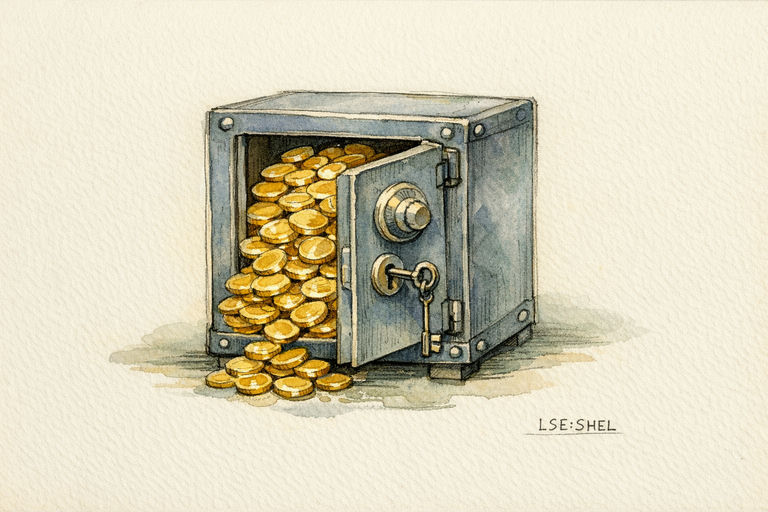
The bypass to a closed strait is now itself closed. That removes something in the order of 4% to 5% of global supply from the market at a stroke, and at the point in the chain where there is no alternative routing. Shell is the largest London-listed read on the crude price, capitalised at around £196bn, and the shares are already trading at record levels. The question is not whether Shell benefits — it obviously does — but how much is already in the price, and what the five factors look like if Brent mean-reverts toward $80 with the company having banked a windfall in between.
What actually happened
The attack was one of a series. Drones launched from Iraqi territory, where Iran-backed militias operate, struck on Thursday morning, causing fires, damage to pump stations and injuries. The energy ministry announced the suspension late on Friday, framing it as precautionary rather than forced.
The significance is structural rather than a matter of tonnage. The East-West pipeline was built precisely for this scenario: a route that lets Saudi crude reach a buyer without passing through Hormuz. With Hormuz transits running around 95% below normal — a handful of commodity crossings a day against a pre-conflict norm well above a hundred — the pipeline had been carrying an outsized share of what was still getting out. Removing it does not just subtract barrels. It subtracts the contingency plan.
Both headline numbers are quoted inconsistently. The line's nameplate capacity is higher than what it was actually moving, and accounts of the rerouted volume cluster around four to five million barrels a day, which is the range used here. Brent is similarly contested at the margins — some accounts have it spiking toward $110 before easing, others settling around $105 to $108 — but every account agrees it broke and held above $100.
Why the market reacted the way it did
Shell's London line closed at 3,443p on 2 September — the price the company itself used to value the acquisition it completed that day — and touched a record 3,530p on 9 September, close to 25% above its July low. Its New York-listed ADSs then reached an all-time high of $95.80 on 12 September, the same day Morgan Stanley upgraded the stock to Overweight.
The market is pricing a change in the shape of the risk, not simply a higher spot price. An integrated major with upstream production is long the barrel; that much is mechanical. The more interesting repricing is that the supply disruption has proved durable rather than episodic. Markets discount a two-week spike very differently from a condition that has persisted for months and keeps finding new ways to get worse. Each successive escalation — Hormuz, then Bab el-Mandeb, now the bypass pipeline — has removed another piece of the optionality that would allow the situation to normalise quickly.
The Openbook read
Momentum is at or near maximum and is entirely externally driven. Shares at record highs in both listings, close to 25% off the July low, and a fresh broker upgrade. On any mechanical momentum screen Shell ranks near the top of the FTSE 100. The caveat is the same one that applies to every commodity producer at a price spike: the factor is measuring the barrel, not the business, and the barrel can reverse in a week if a ceasefire is announced.
Growth is the factor that needs the most careful splitting, because this quarter it has two components that behave completely differently. One is real. Shell completed its acquisition of Canada's ARC Resources on 2 September, adding roughly 370,000 barrels of oil equivalent a day immediately and underpinning a production compound annual growth rate of around 4% through to 2030 against a 2025 base. That is volume the company did not have in June, and it is accretive to free cash flow per share from 2027 on the company's own guidance. The other component is not growth at all: it is the realised price on production Shell already owned, which is a revaluation of existing assets and will unwind symmetrically. Anyone modelling forward earnings off current realisations is capitalising a spot price into perpetuity, which is the single most common error made in energy equities; the ARC barrels add volume, not price, and do not change that.
Profitability was already strong before this leg. Second-quarter results, reported on 30 July, showed Adjusted Earnings of $9.8bn — a non-GAAP measure on Shell's own definition, and the one the company and the market both anchor on — with cash flow from operations of $21.4bn, driven by operational performance and higher realised prices. That was achieved with Brent well below current levels. The read-through to the third quarter is straightforwardly positive on price, though it comes with the usual caveats about trading results, which are volatile and which the company does not guide.
Solvency is the factor that has improved most and attracts the least attention. Net debt fell to $41.8bn at the end of the second quarter from $52.6bn at the end of the first, with gearing down to 18.7% from 23.2%. That is a substantial deleveraging inside a single quarter, with one caveat that postdates the balance sheet: completing ARC on 2 September brought roughly $2.5bn of net debt and leases with it, so the next gearing figure will not be a clean read of the same trend. Even allowing for that, a balance sheet in this condition converts a price windfall into optionality rather than into distress avoidance, which is a materially different position from the one the sector occupied in 2020.
Reward/Risk is where this article earns its keep, and it turns on one observation: Shell does not plan against the spot price. Capital allocation is set against a mid-cycle deck well below $100. That means a spot windfall does not flow into the capital budget or into guided earnings. It flows into the balance sheet and into distributions.
The evidence is in what actually moves the buyback — and it is worth being accurate about this, because the programme has been anything but a metronome in 2026. In May Shell cut the quarterly repurchase from $3.5bn to $3.0bn to preserve financial flexibility. It then suspended the programme entirely between 12 June and 14 July, for securities-law reasons around the ARC shareholder vote, and restarted it on 30 July at $4.2bn: $3.0bn of new authorisation plus $1.232bn carried over from the suspended tranche. Total shareholder distributions in the second quarter came to $5.2bn, comprising $3.0bn of repurchases and $2.2bn of cash dividends, with the quarterly dividend declared at $0.3906 a share.
That is a weaker claim than an unbroken cadence, and better stated plainly than dressed up. What the sequence shows is that the buyback is the discretionary lever — the line that gives way when leverage rises or when management wants to spend something over $16bn on Canadian gas. What it does not show is any sensitivity to spot Brent in either direction. The policy is set against a mid-cycle deck and the balance sheet, not against the screen, and that is the point that survives.
The consequence for a reader is specific. The market has historically declined to capitalise spot-price windfalls in the majors at a normal earnings multiple, and it is right not to. What a $108 Brent actually buys a Shell shareholder is a faster reduction in the share count and a balance sheet with more room, both of which are durable, rather than an earnings base that survives mean reversion. The risk is the mirror image: if Brent returns to $80, the earnings line falls a long way, the distribution policy carries on at whatever the balance sheet will bear, and the shares give back a move they were never fundamentally awarded. Comparing Shell against the sector on gearing and distribution consistency rather than on trailing earnings is the exercise that makes this legible, and our screener is built for that cut.
The read-across
Three groups sit in this flow and they are not the same trade.
- The other integrated majors take the same condition with different gearing. BP is the higher-beta London expression: more financially geared, more operationally leveraged to the barrel, and having spent much of the year recovering from a lower base. It moves further in both directions on the same crude print.
- Refiners are a genuinely different leg and are frequently conflated with this one. Their economics run on crack spreads — the margin between product and crude — not on crude realisations. A rising crude price is a cost to a refiner, not a revenue. What has been driving refining margins is the product side, and US diesel prices have hit an all-time high during this episode. That is a distinct and in some respects stronger story, but it is not this one, and a reader who buys a refiner expecting crude-price exposure has bought the wrong instrument.
- Shipping is a third leg again. Clarkson and the tanker owners earn on the length and number of voyages, not on the price of the cargo. Their economics improve when straits close even if crude falls, because the binding constraint is vessel availability rather than barrel scarcity. The correlation with Shell over the past month is real but incidental — one event is driving both — and it breaks the moment crude eases without the routes reopening.
What to watch next
The pipeline restart. This is the most direct and fastest-moving input. The suspension was explicitly framed as precautionary, which implies the line is capable of restarting once the security assessment allows it. An announced resumption would take a meaningful share of the last week's crude move straight back out, and it could come with little notice.
Hormuz transit counts. The slower but more consequential indicator. Transits are running roughly 95% below normal. This is the condition underpinning the entire premium; the pipeline shutdown only matters because the strait is shut. Any credible movement toward reopening resets the whole complex.
Shell's third-quarter results, due in late October. The first period to capture a meaningful stretch of elevated realisations, and the first to consolidate ARC. The numbers to read are not the headline Adjusted Earnings — those will be good and the market knows it — but the buyback announcement and the gearing figure. Whether the next programme is set above $3bn, having been cut in May and suspended in June, is the cleanest available signal of how management itself is classifying this windfall: temporary cash to be returned, or a durable change in the planning environment.
Any move on the mid-cycle price assumption. Shell has been consistent about planning below spot. If that assumption were revised upward, it would change the capital budget and the shape of everything downstream of it. Nothing suggests it is imminent, and its absence is itself informative.
Discussion
Log in to join the discussion