%20--%3e%3csvg%20width='63.297821mm'%20height='39.29665mm'%20viewBox='0%200%2063.297821%2039.29665'%20version='1.1'%20id='svg8765'%20inkscape:version='1.1%20(c4e8f9ed74,%202021-05-24)'%20sodipodi:docname='OBALogoSingle2.svg'%20xmlns:inkscape='http://www.inkscape.org/namespaces/inkscape'%20xmlns:sodipodi='http://sodipodi.sourceforge.net/DTD/sodipodi-0.dtd'%20xmlns='http://www.w3.org/2000/svg'%20xmlns:svg='http://www.w3.org/2000/svg'%3e%3csodipodi:namedview%20id='namedview8767'%20pagecolor='%23ffffff'%20bordercolor='%23666666'%20borderopacity='1.0'%20inkscape:pageshadow='2'%20inkscape:pageopacity='0.0'%20inkscape:pagecheckerboard='0'%20inkscape:document-units='mm'%20showgrid='false'%20fit-margin-top='0'%20fit-margin-left='0'%20fit-margin-right='0'%20fit-margin-bottom='0'%20inkscape:zoom='1.1759259'%20inkscape:cx='179.85827'%20inkscape:cy='102.04724'%20inkscape:window-width='1920'%20inkscape:window-height='972'%20inkscape:window-x='0'%20inkscape:window-y='27'%20inkscape:window-maximized='1'%20inkscape:current-layer='layer1'%20/%3e%3cdefs%20id='defs8762'%20/%3e%3cg%20inkscape:label='Layer%201'%20inkscape:groupmode='layer'%20id='layer1'%20transform='translate(-31.351095,-50.101677)'%3e%3cpath%20style='fill:none;stroke:%233584e4;stroke-width:3.965;stroke-linecap:square;stroke-linejoin:round;stroke-miterlimit:4;stroke-dasharray:none;stroke-opacity:1'%20d='m%2077.07508,77.78787%2014.84134,8.87817%20V%2052.83397%20L%2034.08359,86.5521%20V%2053.69366%20l%2015.27351,9.31107'%20id='path8388'%20sodipodi:nodetypes='cccccc'%20/%3e%3c/g%3e%3c/svg%3e)
The Best Stock Screeners in 2026
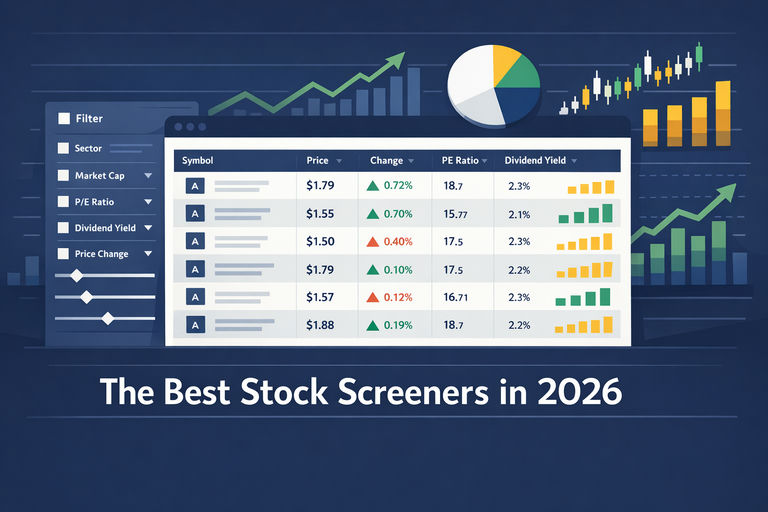
Not all stock screeners are built the same — and choosing the wrong one for your investing style can slow down your research. This guide matches the best stock screener options of 2026 to specific investor strategies, from deep fundamental analysis to active trading, and explains how to use a stock screener to find undervalued stocks effectively.
On this page (12)
Finding the right best stock screener for your needs is less about picking the most popular tool and more about understanding what kind of investor you are. A day trader scanning for momentum breakouts has almost nothing in common with a value investor hunting for cash-generative businesses trading below intrinsic value — and yet both might reach for the same screener by default. In 2026, the landscape of stock screening tools has matured significantly, with platforms now offering hundreds of metrics, historical data going back a decade, AI-assisted filtering, and deep integration with broader research workflows. This guide cuts through the noise by matching the right screener to the right investing approach, so you spend less time configuring tools and more time making informed decisions.
What Is a Stock Screener and Why Does Your Strategy Matter?
A stock screener is a filtering tool that lets you narrow down a universe of thousands of publicly traded companies to a focused shortlist based on criteria you define. Those criteria might include valuation ratios like price-to-earnings (P/E) or price-to-book (P/B), profitability metrics like return on equity (ROE) or operating margins, technical signals like relative strength or moving averages, or analyst estimate data like earnings revisions.
The reason your strategy matters so much when choosing a screener is simple: not all tools are built the same way. Some are optimised for speed and technical pattern recognition. Others are built around deep fundamental data with years of historical context. Using the wrong tool for your approach is like using a hammer to tighten a screw — it might work in a pinch, but you will constantly be fighting the tool rather than benefiting from it.
- Fundamental investors need broad metric coverage, historical financials, and the ability to filter on ratios like EV/EBITDA, free cash flow yield, or ROIC over multiple years.
- Technical traders need real-time data, pattern-based filters, and tight integration with charting tools.
- Dividend investors need yield data, payout ratio history, and dividend growth consistency.
- Growth investors need revenue growth rates, earnings acceleration, and analyst estimate revisions.
With that framework in mind, here is how the leading stock screening tools of 2026 stack up across different investor profiles.
The Best Stock Screener for Fundamental Investors: Koyfin
For investors who prioritise deep fundamental research, Koyfin stands out as the most capable platform in 2026. Its screener offers over 500 metrics spanning fundamentals, technicals, performance, and analyst estimates — more than any other mainstream tool currently available. Crucially, Koyfin supports screening on historical data going back more than 10 years, which means you can filter for companies that have consistently maintained high returns on invested capital (ROIC) or that are currently trading below their own five-year average P/E multiple.
This historical dimension is what separates Koyfin from most competitors. Rather than only seeing where a company stands today, you can assess whether its current valuation is cheap or expensive relative to its own history — a powerful edge when trying to find undervalued stocks. The platform also offers Percentile Ranks, which score a company's metrics on a 0–100 scale relative to its own history, its industry peers, or its geographic region.
Additional strengths include:
- Screening results that can be saved as watchlists and used across other Koyfin tools like earnings calendars and scatter plots
- ETF and mutual fund screening alongside equities
- Multi-currency support for global investors
- Pre-built templates for common screening strategies
Koyfin is best suited to buy-and-hold investors, value-oriented analysts, and anyone who wants their screener to feed directly into a broader research workflow rather than existing as a standalone tool.
The Best Stock Screener for Active Traders: Finviz and TradingView
Active traders have different priorities. Speed, real-time data, and the ability to filter on technical patterns matter far more than ten years of historical balance sheet data. Two platforms dominate this space in 2026: Finviz and TradingView.
Finviz
Finviz has been a staple of the retail trading community since 2007, and for good reason. Its interface is fast, visual, and built for quick market scans. The free version covers US stocks with around 70 metrics, while the Elite plan adds real-time screening, export functionality, alerts, and up to eight years of financial history. Finviz is particularly strong for traders who want to filter by technical patterns — flags, triangles, channel breakouts — alongside basic fundamental criteria like market cap or sector. It is not a tool for deep fundamental research, but as a first-pass filter for active traders, it remains one of the most efficient options available.
TradingView
TradingView takes a different approach by combining a global screener with one of the most advanced charting environments available to retail investors. With around 150 screening metrics and support for equities, ETFs, crypto, and forex, it is the go-to platform for traders who operate across multiple asset classes. The Pine Script editor allows advanced users to build entirely custom screening logic and indicators. The main limitation is depth on the fundamental side — TradingView is not where you go to screen for companies with consistently high free cash flow margins, but it excels at identifying technically interesting setups across global markets.
The Best Stock Screener for Value and Income Investors: Zacks and TIKR
Value and income investors often need a combination of proprietary ranking systems, yield data, and long-term financial history. Two platforms serve this audience particularly well.
Zacks
Zacks has built its reputation around its proprietary stock ranking system, which rates companies from Strong Buy to Strong Sell based on earnings estimate revisions and surprises. For investors who believe that earnings momentum is a reliable predictor of near-term price performance, the Zacks Rank filter is a genuinely useful addition to a fundamental screen. The platform covers around 150 metrics and includes ETF and mutual fund screening. It is primarily US-focused and less customisable than newer platforms, but its research methodology has a long track record and a loyal following.
TIKR
TIKR is a strong option for fundamental investors who want institutional-quality data at a retail price point. It covers over 100,000 global stocks across 92 countries and 136 exchanges, with around 335 screening metrics including valuation, financials, ratios, cash flows, and analyst estimates. TIKR's layout is modelled on the kind of financial data terminals used by professional analysts, making it a natural fit for investors who want to screen globally and then dive deep into individual company financials. The free plan is limited to US stocks, and screening is only available in USD, but the paid tiers offer strong value for the level of data provided.
Try it on real data
Screen UK and US stocks in one place
Openbook's free screener rates every company on a Reward and a Risk score out of 100, so you can rank the whole universe first and add filters afterwards — instead of stacking conditions until the list empties.
How to Use a Stock Screener to Find Undervalued Stocks
Knowing how to use a stock screener effectively is just as important as choosing the right platform. A screener is only as good as the criteria you feed into it. Here is a practical framework for using screening tools to identify potentially undervalued opportunities.
Step 1 — Define your universe. Start by narrowing the market to companies you are actually willing to invest in. This might mean filtering by market cap (e.g., above £500 million), geography (e.g., US and UK-listed stocks), or sector. Avoid screening the entire global market without constraints — the output will be too broad to be useful.
Step 2 — Apply valuation filters. Common starting points include P/E ratio below the sector median, EV/EBITDA below a set threshold, or price-to-free-cash-flow below a historical average. On platforms like Koyfin, you can filter for companies trading below their own five-year average P/E, which is a more nuanced signal than a simple absolute threshold.
Step 3 — Add quality filters. Cheap stocks are not always good stocks. Layer in profitability criteria such as ROE above 15%, operating margins above the sector average, or positive free cash flow. This helps filter out value traps — companies that look cheap because their fundamentals are deteriorating.
Step 4 — Check earnings momentum. A stock can be cheap and high-quality but still go nowhere if earnings estimates are being revised downward. Adding a filter for positive earnings revisions or analyst upgrades can help identify situations where the market may be starting to recognise the value you have already spotted.
Step 5 — Use the output as a starting point, not a conclusion. A screener produces a shortlist, not a portfolio. Every company that passes your filters still needs to be researched individually — reading annual reports, understanding the competitive position, and assessing management quality. The screener gets you to the right neighbourhood; the research tells you which house to buy.
No card required
A free tier with no trial clock
Score-based screening across UK and US equities, P/E, market cap and sector filters, and a saveable watchlist — all on the free plan. Create an account and your screens are still there next time.
Free vs Paid: What Do You Actually Get?
One of the most common questions investors ask when evaluating stock screener recommendations is whether free tools are good enough. The honest answer is: it depends on what you need.
Free tiers on platforms like Finviz, TradingView, Yahoo Finance, and Koyfin are genuinely useful for basic screening. You can filter by sector, market cap, P/E ratio, and a handful of other metrics without spending a penny. For casual investors or those just getting started, this is often sufficient.
Where paid tiers earn their cost is in three areas:
- Historical data: Free plans typically show only current values. Paid plans unlock multi-year historical financials, which are essential for assessing consistency and identifying mean-reversion opportunities.
- Export and integration: The ability to export screening results to a spreadsheet or feed them into other tools is almost always a paid feature.
- Real-time data: For active traders, delayed data is a meaningful handicap. Real-time quotes and screening updates are standard in most paid tiers.
For most serious long-term investors, a mid-tier paid plan on a platform like Koyfin or TIKR — typically in the range of $20–$40 per month — provides a meaningful step up in research capability without breaking the budget.
Choosing the Right Screener for Your Investing Style
The best stock screener is ultimately the one that fits how you actually invest. Here is a quick summary to help you match tool to strategy:
- Deep fundamental research and long-term investing: Koyfin — best metric depth, historical data, and workflow integration
- Active trading and technical analysis: TradingView — best charting integration and multi-asset coverage
- Quick US market scans and pattern recognition: Finviz — fastest and most visual for US equities
- Global fundamental screening on a budget: TIKR — strong data coverage at a competitive price
- Earnings-driven value investing: Zacks — proprietary rank system adds a useful layer of earnings momentum signal
- Beginners and casual investors: Yahoo Finance — accessible, free, and covers multiple asset classes
Conclusion
Stock screening is one of the most powerful habits a serious investor can develop — but only when the tool matches the task. The platforms reviewed here each have genuine strengths, and none of them is universally the best for every investor. What matters is understanding your own investment process: how you define value, what quality signals you trust, and how much time you want to spend in the research phase. Once you are clear on that, choosing the right screener becomes straightforward. Start with the free tier of your preferred platform, build a few test screens, and see whether the output aligns with the kinds of companies you actually want to own. The best stock screening tools are the ones you use consistently — and that means finding one that fits naturally into how you already think about investing.
Next step
Build your first screen in two minutes
Pick a starting score threshold, add one valuation filter and one quality filter, and see what comes back. Every driver behind a score is visible, so you can check why a name made the list.
You can find stocks with the screener.
Related analysis

Co-founder of Openbook Analytics. Andrew studied Finance and Economics at the University of Strathclyde and writes on UK & US equities, stock valuation models, and portfolio strategy.
This article is for information and education only. It is not investment advice and not a recommendation to buy, sell or hold any investment. Openbook Analytics Ltd is not authorised or regulated by the Financial Conduct Authority. Past performance is not a reliable indicator of future results; the value of investments can fall as well as rise and you may get back less than you invest. Do your own research or speak to a qualified financial adviser.